
Carla Monteiro
Tuesday, 01 Sep 2026
 23
23How the Rules for Licensing a Construction Company in Cape Verde Work
 Array
Array


The construction sector in Cape Verde is one of the main drivers of the national economy. However, for a construction company to operate legally, it is not enough simply to be incorporated as a commercial company; it must also comply with a series of technical and legal requirements set out in Decree-Law No. 45/2010, the legislation governing entry into and continued operation within the construction sector.
Simply being a company is not enough: a licence is required
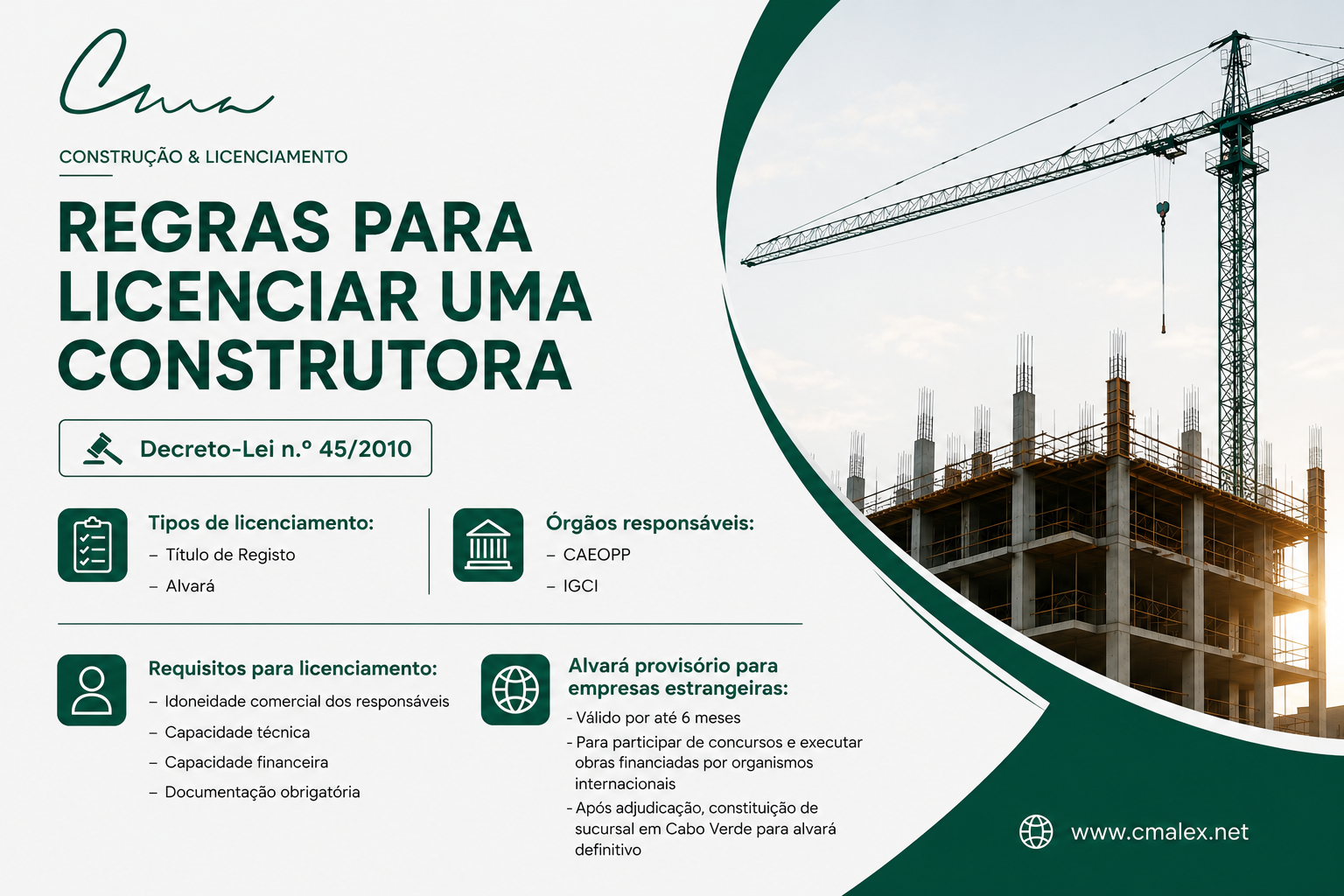
Decree-Law No. 45/2010 is clear on this point: any company wishing to carry out construction work must hold a ‘registration certificate’ or a ‘construction licence’, depending on the scale of the works to be carried out.
This means that it is not enough for a company to be incorporated as a commercial company, even if its corporate purpose relates to construction.
Without the appropriate licence, the company is barred from tendering for, or carrying out, large-scale public or private works.
Who grants licences to and regulates construction companies?
The body responsible for issuing licences, defining categories and technical qualifications – hereinafter referred to as the body responsible for the process – is the CAEOPP (Commission for the Licensing of Public Works and Private Companies).
Decree-Law No. 45/2010 grants this body the powers to:
- to issue licences and registration certificates;
- classify companies by category and class;
- to suspend, cancel or renew licences;
- to monitor compliance with the sector’s rules.
The body responsible for the registration and supervision of companies in the sector is the IGCI (General Inspectorate for Property and Construction).
Registration Certificate v Construction Licence: what’s the difference?
The legislation distinguishes between two types of authorisation:
- Registration Certificate -this is a document intended for companies carrying out smaller-scale works. It sets a maximum value limit for the works the company may undertake.
- Construction Licence – this is the type of document required of companies wishing to carry out larger and more complex projects. Licences are granted in classes (1 to 9), which determine the maximum value of the projects the company may undertake.
A construction licence is mandatory for companies that wish to:
– Work on public works;
– Carry out works of greater economic scale;
– To work on complex projects.
What are the requirements for obtaining a licence?
- Integrity of applicants: the company and its managers must demonstrate that they operate lawfully and ethically;
- Technical capacity: it is necessary to provide qualified technical staff (engineers, architects, site managers, etc.) with proven experience in the field, and to demonstrate the professional relationship between these staff members and the company.
- Financial capacity: the company must demonstrate financial soundness commensurate with the category of licence it wishes to obtain.
- Required documentation such as:
– Certificates of company registration and criminal record;
– Declarations of integrity;
– Work accident insurance for employees;
– CVs and certificates of technical staff;
– Evidence of work carried out (where applicable).
Provisional construction licence: the gateway for foreign companies to the Cape Verdean construction sector.
With the growth in projects funded by international institutions and bilateral agreements, Cape Verde has become an attractive destination for foreign companies in the construction sector. Decree-Law No. 45/2010 recognises this reality and establishes a streamlined and strategic mechanism: the provisional licence.
What is a provisional construction licence?
It is a temporary authorisation, valid for up to six months, granted by CAEOPP (the Commission for the Licensing of Public Works and Private Companies) to foreign companies with recognised technical, economic and financial standing. It allows them to take part in international tenders and to carry out public works projects funded by multilateral organisations or under international agreements.
What are the requirements?
- The company must be based abroad and submit the necessary documentation; there is no need for an immediate local presence.
- Once the contract has been awarded, the company has up to 6 months to set up a branch in Cape Verde and obtain the permanent licence.
- Whilst the provisional licence is valid, the company may take part in other similar tenders.
The provisional licence is more than just a permit: it is a public policy instrument that strikes a balance between openness to foreign investment and requirements for quality and accountability. For international companies, it represents an opportunity; for Cape Verde, it is a tool for strategic development.